Certificate of Analysis
Lab reports coming soon. HPLC, Mass Spec & endotoxin testing.
MSDS
Material Safety Data Sheet coming soon. Handling & storage info for laboratory use.
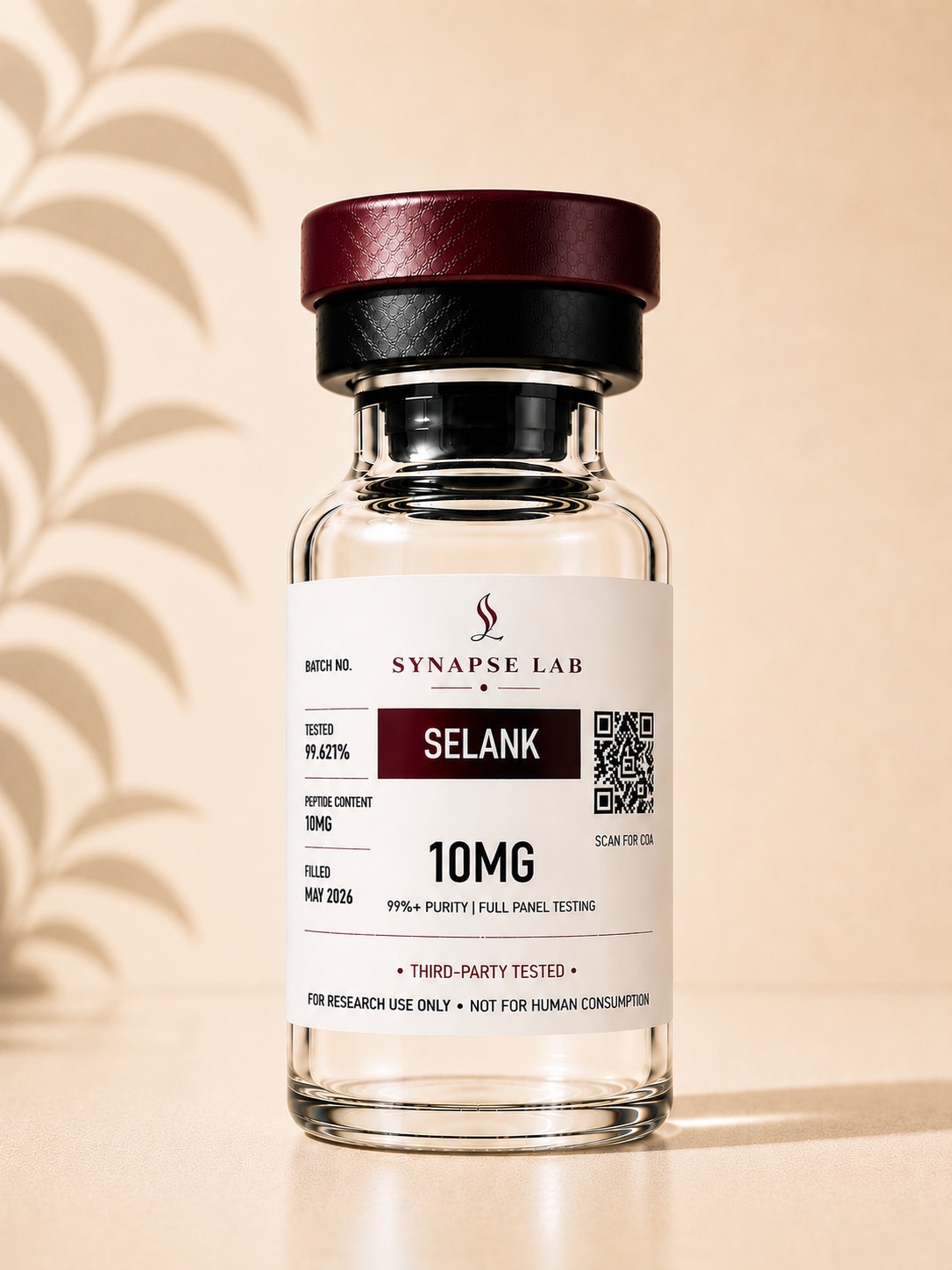
Selank
Research Compound
Compound Overview
Selank is a synthetic heptapeptide derived from the naturally occurring immunomodulatory peptide Tuftsin, a short fragment associated with immunoglobulin G (IgG). Developed as a stabilized analog of Tuftsin, Selank has been extensively investigated for its potential involvement in neurotransmitter regulation, neuroplasticity, stress adaptation, and immune signaling pathways. Research suggests the peptide may interact with multiple neurochemical systems simultaneously, including serotonin, GABAergic, and enkephalin pathways, making it a significant focus in experimental neuroscience and neuroregulatory research. Structurally, Selank combines the Tuftsin sequence with an added Pro-Gly-Pro (PGP) fragment at the C-terminal end. Researchers theorize this modification may improve molecular stability and potentially enhance the peptide’s ability to traverse biological barriers such as the blood-brain barrier (BBB). Due to these properties, Selank has been explored in experimental models involving cognitive performance, stress response, emotional regulation, inflammatory signaling, and adaptive neurochemical processes.
Molecular Formula: C33H57N11O9 Molecular Weight: 751.88 g/mol Other Known Titles: TP-7, Selanc
Research suggests Selank may influence several neurotransmitter systems simultaneously, particularly serotonin and gamma-aminobutyric acid (GABA) pathways. Experimental models indicate the peptide may alter serotonergic signaling in regions associated with emotional processing and stress adaptation. In studies where serotonin synthesis was experimentally suppressed, Selank exposure appeared to normalize serotonin metabolism within the brainstem and other neurologically active regions.
Selank has also been investigated for its potential interaction with the GABAergic system. GABA is considered the primary inhibitory neurotransmitter within the central nervous system and is closely associated with neuronal relaxation and excitability regulation. Gene expression analyses conducted in murine models demonstrated that Selank exposure produced patterns similar to those observed following direct GABA exposure, suggesting the peptide may exert modulatory activity on GABA-related signaling pathways. Researchers further theorize that Selank may influence neurotransmission through allosteric mechanisms rather than direct receptor activation alone, potentially contributing to longer-lasting neuroregulatory effects.
Studies have explored the peptide’s potential influence on brain-derived neurotrophic factor (BDNF), a protein considered critical for neuronal survival, synaptic plasticity, and neuroadaptive processes. Experimental findings suggest Selank may elevate BDNF mRNA expression in the hippocampus, a brain region heavily associated with memory formation and emotional regulation.
Researchers theorize this increase in BDNF signaling may support neuronal adaptability during periods of experimentally induced stress, particularly in models where glucocorticoid exposure suppresses normal neurotrophic activity. These findings have led to continued investigation of Selank within experimental neuroplasticity and cognitive resilience research.
Selank has been widely investigated in experimental learning and memory models. In conditioned avoidance response (CAR) studies involving murine models, peptide exposure prior to training sessions appeared associated with improved learning efficiency, reduced error frequency, and increased successful task completion rates over repeated testing periods.
Researchers propose these observations may result from the peptide’s potential influence on neuropeptide signaling, neurotransmitter balance, and synaptic plasticity. Additional hypotheses suggest Selank may indirectly improve cognitive performance by reducing stress-related interference with learning processes, potentially supporting more stable memory consolidation and neural adaptability.
Experimental findings suggest Selank may influence endogenous opioid peptide systems, particularly enkephalins. Researchers theorize the peptide may suppress enzymes responsible for degrading enkephalins, potentially increasing their concentration within neural tissues.
Enkephalins are believed to participate in the regulation of stress response, mood signaling, and nociceptive processing. In comparative studies involving generalized anxiety models, Selank exposure appeared associated with altered levels of tau leu-enkephalin and neurochemical responses similar to those observed with conventional anxiolytic compounds, while maintaining a distinct signaling profile.
Because Selank originates from the Tuftsin peptide family, researchers have also explored its potential immunomodulatory properties. Experimental studies suggest Selank may influence cytokine expression, including alterations in IL-6 levels and shifts in Th1/Th2 cytokine balance, both of which are considered relevant in immune signaling regulation.
Additional genome expression studies involving spleen and hippocampal tissues indicated the peptide may alter expression of genes associated with inflammatory pathways, including CX3CR1-related signaling mechanisms. Researchers continue to investigate whether these observations reflect broader neuroimmune regulatory interactions.
Selank has also been studied in experimental models involving stress adaptation and withdrawal-like states. In murine studies involving prolonged ethanol exposure followed by induced withdrawal conditions, peptide exposure appeared associated with improved social interaction behavior and reduced stress-associated responses during maze testing.
Researchers speculate these findings may involve combined modulation of neurotransmitter balance, neuropeptide signaling, and stress-response circuitry within the central nervous system.
Additional investigations have explored Selank’s potential influence on vascular and metabolic parameters. Experimental models reported transient reductions in arterial blood pressure alongside temporary increases in cerebral blood flow following peptide exposure. No substantial alterations in respiratory activity or heart rate were observed in these specific studies.
Metabolic research models involving high-fat dietary conditions also suggested potential changes in lipid metabolism following Selank exposure. Researchers observed apparent reductions in cholesterol, triglycerides, and certain lipoprotein fractions, alongside improved fibrinolytic activity and stabilized body weight measurements in experimental subjects.
Selank peptide is available strictly for laboratory and research purposes only. This compound is not intended for human consumption, therapeutic application, or diagnostic use.
The Synapse Quality Standard
Every compound undergoes a rigorous multi-stage verification process before receiving our seal of approval.
HPLC Testing
High-performance liquid chromatography ensures precise purity measurement for every synthesized batch.
Mass Spec Verification
Mass spectrometry confirms molecular identity and detects trace impurities at parts-per-billion sensitivity.
Endotoxin Analysis
LAL assay screening for bacterial endotoxins, kept well below industry safety thresholds.
ISO 17025 Compliance
Our laboratory operations are accredited under ISO 17025, the international standard for testing competence.
Molecular Specifications
Thr-Lys-Pro-Arg-Pro-Gly-Pro751.9 g/mol129954-34-3